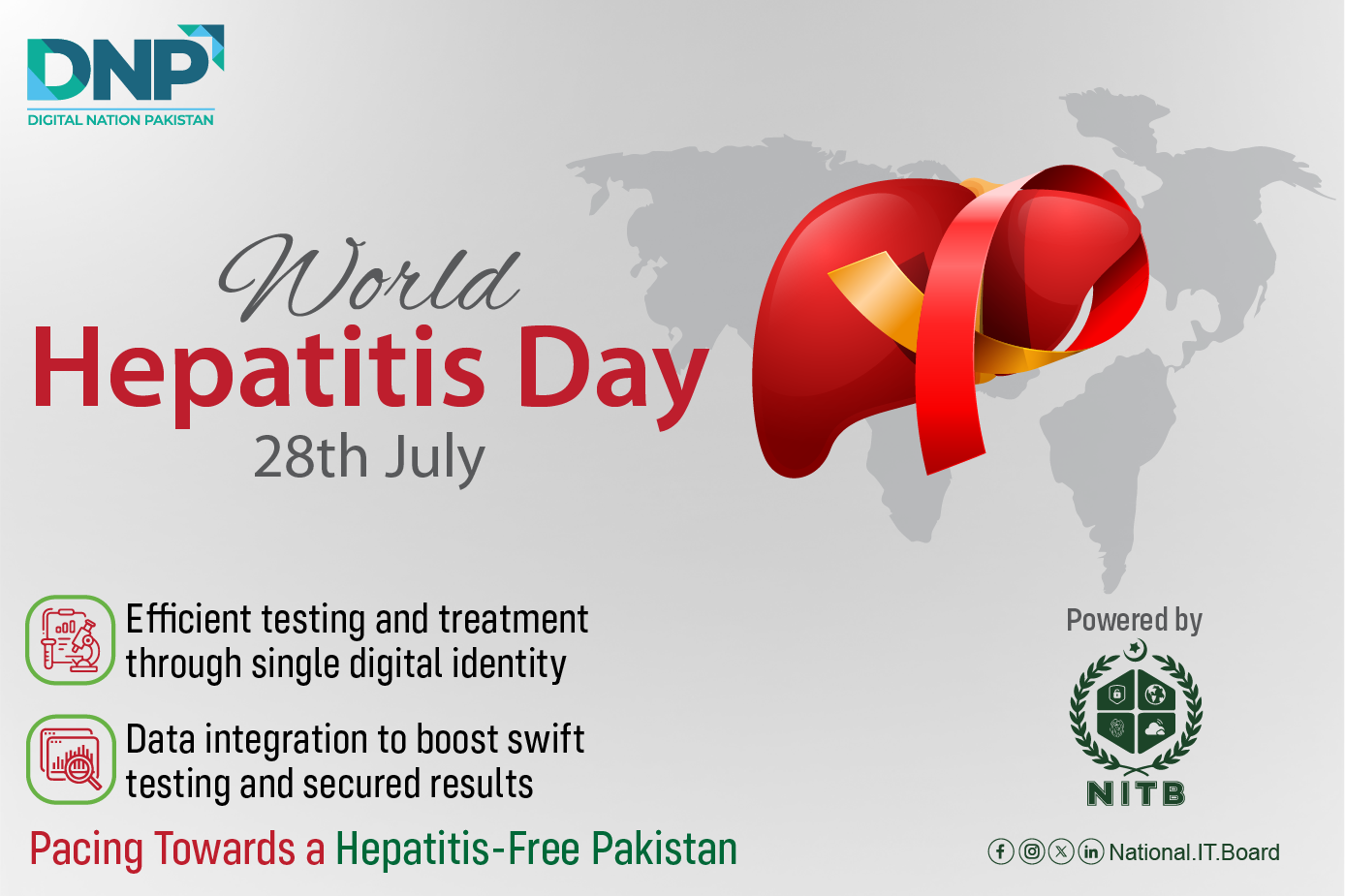
To honor the legacy of Nobel Laureate Dr. Baruch Blumberg (the visionary who discovered the Hepatitis B virus and developed its first vaccine), the National Information Technology Board (NITB) is actively tackling one of the world’s biggest healthcare challenge in this regard: the low coverage of screening, testing, and continuous treatment.
With "One Patient, One ID" initiative, NITB is bridging this critical gap and spearheading Pakistan’s mission to achieve the WHO 2030 elimination goals.
The True Impact of Digital Healthcare Innovation:
- Unified Patient Diagnostics: By seamlessly securely linking every citizen’s clinical history to a single digital identity (CNIC), One Patient One ID enables instant cross-hospital medical history access. Doctors can now track screening timelines, ensuring patients never fall through the cracks of the system.
- Secured, Rapid Data Integration: No more fragmented, delayed paper records. The cutting-edge digital infrastructure unifies data across healthcare facilities. This ensures swift testing deployment, tamper-proof digital results, and absolute tracking continuity to eliminate treatment dropouts completely.
- Data-Driven Public Health Strategy: Serving as the digital backbone of the state, NITB empowers healthcare policymakers with precision, real-time national analytics. By pinpointing screening coverage gaps instantly, we can direct critical health resources exactly where they are needed most.
WHAT MUST BE DONE?
For the Public:
- Get tested for hepatitis B and C.
- Promote routine Hepatitis B testing in Antenatal care setting and antiviral prophylaxis where needed, as part of triple elimination of HIV, hepatitis and syphilis.
For Communities and Civil Society:
- Advocate for increased political commitment, financing and accountability for hepatitis elimination.
- Combat stigma and discrimination and promote awareness, demand for services and community engagement.
For Policy-makers and Governments:
- Lead and fund awareness campaigns on hepatitis elimination.
- Expand hepatitis B birth-dose vaccination, safe blood/injection practices, and harm reduction.
For National Health Authorities:
- Prioritize early diagnosis and treatment, focusing on high burden and underserved communities.
- Decentralize services to primary and district health centers.
 NITB
NITB